
Better renovation results are usually decided before the first tile is removed, the first wall is opened, or the first finish is ordered. Experienced renovation experts know that day one is not demolition day. It is the moment when goals, constraints, technical details, budget expectations, and communication habits are aligned into one workable plan.
For homeowners and business owners in Dubai, this early planning matters even more. Properties vary widely, from villas and apartments to retail units and offices, and each space can involve building management rules, service access limitations, MEP conditions, approval requirements, and strict timelines. A beautiful design can still become stressful if the planning behind it is weak.
The best renovation experts prevent that by treating the first phase as a structured decision-making process. They do not simply ask what you want to change. They ask why it matters, how the space must function, what the building allows, and what must happen first for the final result to feel seamless.
Day One Starts With the Real Goal, Not Just the Visible Problem
Many renovation requests begin with a surface-level issue: an outdated kitchen, a cramped bathroom, poor lighting, worn flooring, or a layout that no longer suits daily life. Skilled renovation experts look beyond that first complaint to understand the real goal behind the project.
For example, a homeowner may ask for a kitchen makeover because the cabinetry looks dated. During the consultation, the actual problem may turn out to be poor storage, weak task lighting, limited countertop space, and an uncomfortable cooking flow. If the team focuses only on replacing cabinets, the space may look newer but still fail to work better.
This is why the first conversation should clarify lifestyle, routines, priorities, and pain points. In a home, that may include how many people use the space, whether the family entertains often, how much storage is needed, and which areas feel uncomfortable. In a commercial renovation, it may include customer flow, staff productivity, brand presentation, durability, and compliance needs.
A strong renovation brief usually captures:
- The main purpose of the renovation
- The spaces included in the project
- Functional problems that must be solved
- Style preferences and material expectations
- Budget comfort level and flexibility
- Desired completion window
This brief becomes the foundation for every decision that follows. Without it, the project can drift into disconnected choices that look appealing individually but do not support the bigger goal.
Site Surveys Turn Ideas Into Practical Plans
A design concept only becomes reliable once it has been tested against the real site. Renovation experts inspect the property early because existing conditions often influence what is possible, what needs upgrading, and where costs may appear.
In Dubai homes and commercial spaces, early technical checks are especially important for kitchens, bathrooms, AC systems, electrical loads, plumbing routes, drainage, wall conditions, ceilings, flooring levels, and waterproofing. Even a simple-looking interior upgrade can involve hidden services behind walls or ceilings.
A careful site survey helps the renovation team identify risks before work begins. If a wall cannot be removed, if plumbing cannot be shifted easily, or if the ceiling height limits lighting options, those facts should shape the design from the start. Discovering them halfway through the renovation can affect cost, timing, and quality.
This is also where professional experience protects the client. A trained eye can notice details that are easy to miss, such as damp patches, uneven surfaces, overloaded circuits, weak ventilation, or poor previous workmanship. The goal is not to make the project more complicated. The goal is to make it more predictable.
If you want a broader view of what a professional process includes from consultation to handover, Revo Craft Renovations explains the client journey in its guide to professional renovation home services.
Scope Clarity Prevents Costly Assumptions
One of the biggest differences between average planning and expert planning is the level of scope detail. A vague scope might say, “renovate kitchen.” A professional scope defines cabinetry, countertops, backsplash, plumbing changes, electrical points, lighting, appliances, wall finishes, flooring, ceiling work, painting, protection, disposal, and installation responsibilities.
This matters because unclear scope creates assumptions. The client may assume something is included, while the contractor may have priced only the basic work. Later, that gap becomes a variation, delay, or disagreement.
Renovation experts reduce this risk by breaking the project into clear work categories. They clarify what is included, what is excluded, what is provisional, and what depends on site conditions. This does not remove every possible surprise, especially in older properties, but it makes the project far easier to manage.
A detailed scope also helps with sequencing. Electrical work must happen before wall closing. Waterproofing must be completed and tested before tiling. Custom joinery needs confirmed measurements before fabrication. Paint and final finishes should happen after dusty work is complete. When the scope is clear, each trade knows when and how to contribute.
Design, Renovation, and Execution Should Be Planned Together
A common renovation mistake is separating design from execution too early. A mood board can be inspiring, but it is not enough to guide a build. Materials, dimensions, service routes, joinery details, and site constraints must be considered alongside the visual concept.
This is where renovation experts create better outcomes from day one. They understand that the design must be buildable, maintainable, and aligned with the budget. They also know that the best interior result depends on technical planning, not only aesthetics.
For example, a floating vanity may require wall support and revised plumbing. A feature ceiling may require coordination with AC diffusers, lighting, speakers, and access panels. A seamless kitchen design may depend on appliance dimensions, socket locations, and countertop fabrication details. If these choices are coordinated early, the final result feels intentional rather than adjusted on site.
For homeowners considering both structural changes and finish upgrades, it is useful to understand how remodeling and renovation work together in one plan. Coordinating both sides helps avoid rework and improves the flow between design intent and site execution.
Budget Planning Is About Priorities, Not Guesswork
A professional budget is more than a total number. It is a decision tool. Renovation experts help clients understand where money should be spent for the greatest impact and where simpler choices may still deliver a polished result.
Early budget conversations can feel uncomfortable, but they are essential. Without a realistic budget range, the design may develop in a direction that is not financially practical. This leads to redesign, delays, or disappointing compromises later.
A better approach is to align budget with priorities from the start. If the kitchen is the heart of the home, custom cabinetry, durable countertops, and high-quality hardware may deserve more investment. If a rental property needs a fast refresh, durable finishes and efficient upgrades may matter more than luxury details. If a business space must reopen quickly, schedule certainty may be as important as design ambition.
| Planning area | What renovation experts clarify early | Why it improves the result |
|---|---|---|
| Goals | The reason behind the renovation | Keeps decisions focused on real needs |
| Site conditions | Existing MEP, structure, surfaces, and access | Reduces surprises during execution |
| Scope | Exact works, exclusions, and dependencies | Prevents misunderstandings and variations |
| Budget | Priority areas and realistic allowances | Supports smarter material and design choices |
| Schedule | Lead times, work sequence, and approvals | Helps the project move with fewer delays |
| Communication | Decision points and update rhythm | Keeps everyone aligned throughout the work |
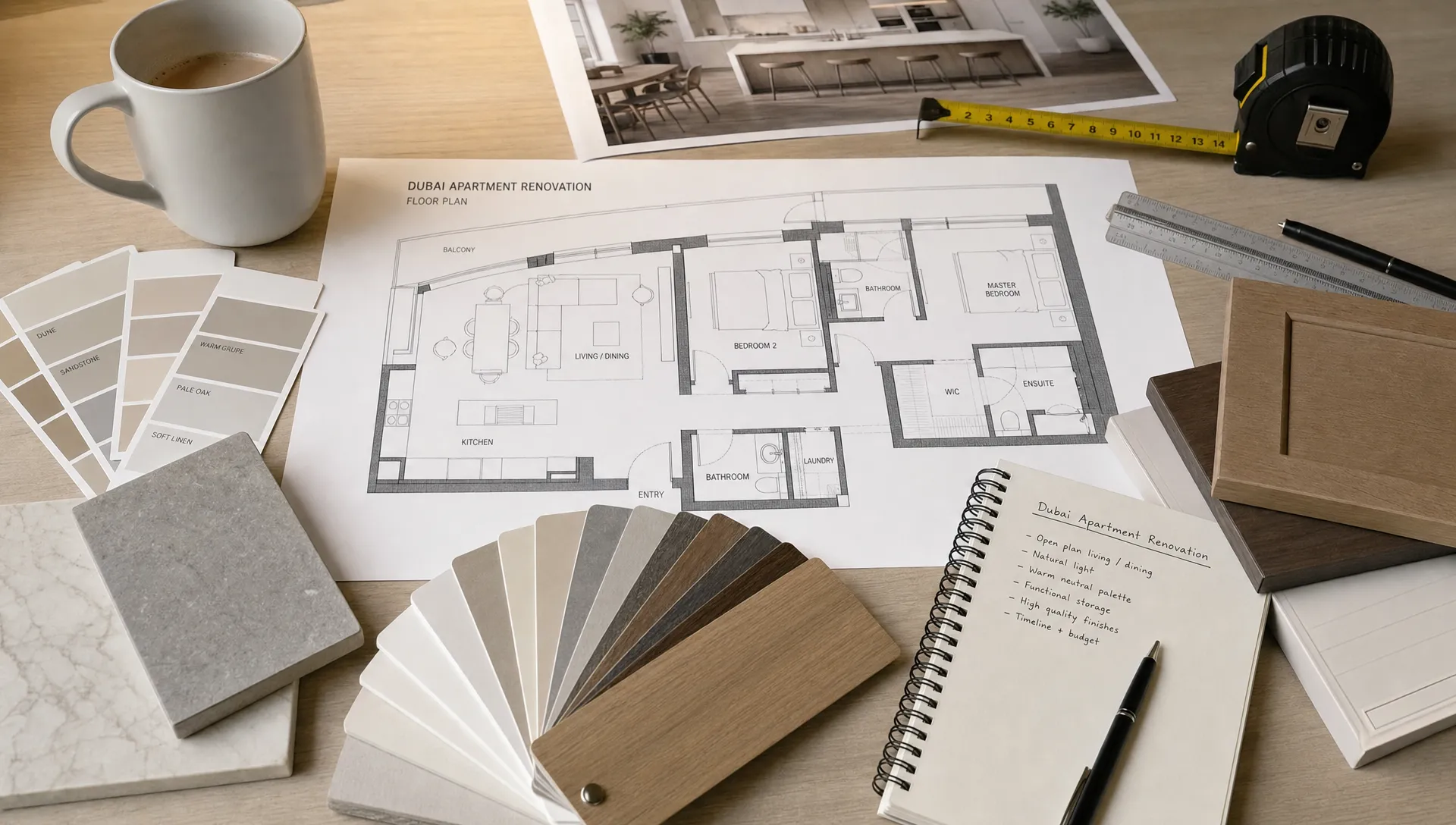
Material Choices Need Timing as Much as Taste
Material selection is often one of the most enjoyable parts of renovation, but it can also become a major source of delay if handled too late. Tiles, countertops, sanitaryware, light fixtures, flooring, hardware, and custom finishes may have lead times, stock limits, or installation requirements.
Renovation experts plan material decisions early because every finish affects something else. Tile size affects wastage, layout, and cutting. Countertop thickness affects cabinet detailing. Flooring choice affects door clearance and skirting. Lighting choice affects ceiling design and wiring. Wall finishes affect surface preparation.
In Dubai, availability can also change quickly, especially for imported finishes or specific luxury items. A professional team will usually help clients confirm selections, check compatibility, and schedule procurement in time for installation. This is not just about shopping earlier. It is about protecting the project sequence.
Material planning should balance appearance, durability, maintenance, and suitability for the space. A finish that looks beautiful in a showroom may not be ideal for a high-humidity bathroom, a busy family kitchen, or a commercial reception area with heavy foot traffic. Experts consider how the material will perform after handover, not just how it looks on installation day.
Better Results Depend on Trade Coordination
Renovation projects involve many moving parts. Even a compact apartment renovation may require demolition, masonry, plumbing, electrical work, HVAC adjustments, gypsum, waterproofing, tiling, carpentry, painting, cleaning, and final snagging. In larger homes or commercial properties, the coordination becomes more complex.
Renovation experts improve results by planning how trades interact. They know that one delayed activity can affect several others. If electrical points are not finalized, cabinetry may be delayed. If waterproofing is rushed, bathroom durability may suffer. If ceiling access panels are forgotten, maintenance becomes difficult later.
Good coordination includes clear drawings, confirmed measurements, work sequencing, procurement tracking, and regular site supervision. It also includes quality checkpoints before the next trade covers the previous work. For example, plumbing should be checked before walls are closed, waterproofing should be tested before tiling, and joinery measurements should be confirmed after relevant surfaces are prepared.
This is where project management becomes a practical advantage. It keeps the renovation from becoming a series of isolated tasks and turns it into one controlled process.
Communication Systems Keep Decisions Moving
Renovation delays are not always caused by construction problems. Many are caused by slow decisions, unclear approvals, missing information, or inconsistent communication. From day one, renovation experts establish how updates will be shared, who approves decisions, and when client input is needed.
Clear communication is especially valuable when clients are busy, traveling, or managing a commercial space that must continue operating. A defined update rhythm reduces uncertainty and keeps the project moving. It also creates a record of decisions, which helps avoid confusion later.
Technology is playing a growing role in this part of project delivery. Many renovation businesses now use digital workflows, shared files, scheduling tools, and automation to reduce manual follow-up. Companies outside construction are doing the same, and teams exploring operational efficiency can look at custom web and AI platforms for process automation as one example of how tailored technology can make complex work easier to manage.
For renovation clients, the key point is simple: ask how communication will happen before the project starts. A good team should be able to explain when you will receive updates, how approvals are handled, and how changes are documented.
Approval and Building Rules Should Be Considered Early
In Dubai, renovation planning often involves more than the client and contractor. Depending on the property, approvals or permissions may be required from building management, community developers, authorities, free zone bodies, or mall management. Requirements vary based on location, property type, and the nature of the work.
Renovation experts consider these factors before work begins. They check access rules, working hours, lift booking requirements, material movement procedures, waste disposal arrangements, and noise restrictions. For commercial spaces, they may also need to consider operational disruption, customer safety, signage, and handover deadlines.
Ignoring these details can create avoidable delays. A team may be ready to start, but if access is not approved or documents are missing, the project stalls. Early planning helps align the design, schedule, and site logistics with the rules of the property.
This is also where experience with local renovation conditions becomes valuable. Dubai projects often move quickly, but speed only works when preparation is strong.
Risk Planning Makes the Project More Predictable
No renovation expert can guarantee that every hidden condition will be known before work starts. However, experienced professionals can identify likely risks and prepare for them. This is a major reason expert-led renovations feel more controlled.
Risk planning may include provisional allowances, contingency time, alternative material options, and inspection points after demolition. It may also include advice about which areas should not be rushed, such as waterproofing, electrical safety, structural checks, and custom joinery detailing.
The aim is not to make the client worry. It is to prevent panic decisions. When possible issues are discussed early, the team can respond more calmly if they appear. That leads to better decisions and fewer compromises.
For a deeper look at what can go wrong when early preparation is weak, see these construction renovation planning mistakes to avoid.
What Renovation Experts Usually Decide Before Work Begins
By the time site work starts, a strong renovation team should have already clarified the core project framework. Some details may still be refined, but the major decisions should not be vague.
Before execution begins, renovation experts typically confirm:
- The approved scope of work and priority areas
- Site measurements and technical constraints
- Concept direction, layouts, and key finishes
- Budget structure and provisional items
- Material selections that affect schedule
- Required approvals, access, and logistics
- Trade sequence and major milestones
- Communication method and approval process
When these items are handled early, the renovation starts with momentum. The team knows what to do, the client knows what to expect, and the project has a stronger chance of finishing on time with fewer disputes.
How Clients Can Help Experts Plan Better
A successful renovation is a collaboration. Even the best renovation experts need timely input from the client, especially during the planning phase. Homeowners and business owners can make the process smoother by being honest about budget, clear about priorities, and responsive when decisions are needed.
It also helps to share inspiration images with context. Instead of saying “I like this kitchen,” explain what you like about it. Is it the color palette, the storage, the lighting, the island shape, or the overall mood? This helps the renovation team translate inspiration into a practical design for your actual space.
Clients should also raise lifestyle needs that may not be obvious during a site visit. For example, a family may need child-friendly surfaces, hidden storage, pet-friendly flooring, or better sound control. A business may need durable finishes, quick maintenance access, or phased work to reduce downtime.
The more complete the information on day one, the better the plan becomes.
Frequently Asked Questions
Why do renovation experts spend so much time planning before work starts? Early planning helps clarify goals, scope, technical conditions, budget, materials, approvals, and schedule. This reduces surprises and gives the project a stronger structure before site work begins.
What should I prepare before meeting renovation experts? Prepare your goals, photos of the space, inspiration images, must-have features, budget expectations, timeline preferences, and any building management rules you already know. This helps the first consultation become more productive.
Can renovation experts help if I only have a rough idea? Yes. A professional renovation team can help turn a rough idea into a practical brief by asking about lifestyle, function, style, technical needs, and priorities.
Why is a site survey important before final pricing? A site survey allows the team to check measurements, existing services, access, surface conditions, and possible constraints. Without this, pricing may be based on assumptions rather than the actual property.
How early should I choose materials for a renovation? Key materials should be selected as early as possible, especially items that affect measurements, installation, or lead times. This includes tiles, flooring, sanitaryware, lighting, countertops, and custom joinery finishes.
Plan Your Renovation With Confidence From Day One
Better renovation results do not happen by chance. They come from clear goals, careful site checks, detailed scope planning, realistic budgeting, coordinated trades, and transparent communication from the beginning.
Revo Craft Renovations helps homeowners and businesses in Dubai plan bespoke renovation and interior transformation projects with attention to comfort, style, functionality, and craftsmanship. Whether you are upgrading a home, remodeling a kitchen, improving interiors, or coordinating technical and finishing work, the right planning process can make every stage smoother.
If you want your renovation to feel organized from the first conversation, start with a team that treats day one as the foundation for everything that follows.