
A successful house renovation in Dubai starts long before demolition, tile samples, or cabinet designs. The smoother projects are usually the ones where homeowners make clear decisions early, understand building rules, and prepare for the realities of renovating in a fast-moving city with strict community guidelines, climate demands, and high expectations for finish quality.
Whether you are refreshing a townhouse, upgrading a villa, or transforming an older family home, planning is what protects your budget, timeline, and final result. Use the tips below to approach your renovation with more confidence and fewer surprises.
Start With the Outcome, Not the Materials
Many homeowners begin with finishes: marble, wall panels, kitchen cabinets, paint colors, lighting fixtures. These choices matter, but they should come after you understand what the renovation is meant to achieve.
Before speaking to contractors or visiting showrooms, define the main reason for the project. Are you renovating to improve daily comfort, increase resale value, prepare the property for rental, modernize an outdated layout, or support a growing family? Each goal leads to different decisions.
For example, a house renovation for long-term family living may justify custom storage, premium flooring, and upgraded electrical capacity. A renovation for resale may focus more on neutral finishes, kitchen and bathroom improvements, lighting, and visible maintenance issues. A rental-focused property may need durable, easy-to-maintain materials rather than highly personalized luxury details.
The clearer your goal, the easier it becomes to decide what deserves investment and what can be simplified.
Create a Practical Renovation Brief
A renovation brief is a simple document that explains what you want, what you want to avoid, and how the home should work after the project. It does not need to be complicated, but it should be specific enough to guide design, pricing, and execution.
Include these details in your brief:
- Property type, location, and approximate size
- Rooms included in the renovation
- Must-have upgrades and nice-to-have features
- Preferred design style and reference images
- Known pain points, such as poor storage, dark rooms, outdated bathrooms, or weak ventilation
- Budget range and desired completion period
- Whether you will live in the property during the work
This brief helps a renovation company understand the project faster and reduces the chance of vague quotations. It also helps you compare proposals fairly, because each contractor is responding to the same requirements.
Study the Property Before Finalizing the Design
Dubai homes can vary widely in construction type, community rules, building age, and existing MEP systems. A design that looks simple on paper may become expensive if it requires major plumbing relocation, structural changes, or hidden repair work.
A proper site assessment should happen before the final scope and quotation. The goal is to identify constraints early, not after demolition has started.
| Planning area | Why it matters | Questions to ask |
|---|---|---|
| Existing layout | Some walls, shafts, and service zones may limit changes | Can this wall be modified, or is it structural or service-related? |
| Electrical capacity | Modern kitchens, lighting, and appliances may need upgrades | Is the current load suitable for the new plan? |
| Plumbing routes | Relocating bathrooms or kitchens can increase cost and approval needs | Can drainage and water lines support the proposed layout? |
| AC and ventilation | Comfort depends on airflow, duct condition, and humidity control | Will the renovation affect cooling performance? |
| Waterproofing | Bathrooms, balconies, and wet kitchens need proper protection | Will waterproofing be redone and tested before tiling? |
| Building rules | Communities and towers may restrict working hours, noise, and access | What approvals, NOCs, or permits are required? |
This stage is especially important for older villas and apartments where previous modifications may not be fully documented.
Plan Around Dubai Approvals and Community Rules
One of the most common causes of renovation delays in Dubai is underestimating approvals. Requirements vary depending on the property location, building type, freehold community, developer, and scope of work.
Some projects may only need building management approval. Others may require a no-objection certificate, community approval, or submissions to the relevant authority. Villa communities, apartment towers, and commercial spaces often have different procedures.
You should clarify approval requirements before committing to a start date. Ask your renovation team who will prepare drawings, who will submit documents, and how approval timelines may affect the schedule. Also confirm practical rules such as work permits, contractor access, security passes, elevator bookings, waste disposal, working hours, and noise restrictions.
Good planning does not remove approval steps, but it prevents them from becoming last-minute obstacles.
Build a Budget With Priorities and Contingency
A realistic budget is not just a single number. It should show how money is divided across design, technical work, finishes, labor, custom items, and contingency. This is where many homeowners accidentally overspend, because they focus heavily on visible finishes while underestimating hidden work.
Technical items such as plumbing, waterproofing, electrical upgrades, AC adjustments, and surface preparation may not be glamorous, but they protect the renovation from future problems. In Dubai, where heat, humidity, and heavy AC use can expose weak workmanship, these hidden details are especially important.
| Budget category | What it may include | Planning tip |
|---|---|---|
| Design and planning | Layouts, drawings, selections, site coordination | Finalize enough detail before pricing to avoid vague estimates |
| Demolition and preparation | Removal, protection, waste handling, surface repair | Check whether removal and disposal are included in the quotation |
| MEP works | Electrical, plumbing, AC coordination, waterproofing | Do not cut corners on safety or concealed systems |
| Finishes | Flooring, tiles, paint, wall finishes, sanitaryware | Choose durable finishes suited to Dubai conditions |
| Joinery and carpentry | Wardrobes, kitchens, vanities, storage units | Allow time for measurement, production, and installation |
| Contingency | Unforeseen site conditions or approved changes | Keep a reserve instead of spending the full budget upfront |
As a general planning habit, separate essential upgrades from optional enhancements. If costs increase, you will know what can be postponed without compromising the core quality of the renovation.
Sequence the Work Before You Start
A house renovation is not just a collection of tasks. It is a sequence. If work happens in the wrong order, finished surfaces may need to be opened again, deliveries may arrive too early, or trades may block each other on site.
The typical sequence often moves from protection and demolition to MEP work, waterproofing, ceiling and wall preparation, tiling or flooring, joinery installation, painting, fixtures, testing, cleaning, and snagging. The exact order depends on the project, but the principle is the same: concealed technical work should be completed and inspected before visible finishes are installed.
This is why a project schedule should be more than a promised completion date. It should identify key milestones, decision deadlines, procurement dates, and inspection points. For larger renovations, a weekly progress review can help keep everyone aligned.
Choose Materials for Dubai’s Climate and Lifestyle
Materials that perform well in one climate may not always be ideal for Dubai. Heat, sunlight, humidity, dust, frequent AC use, and indoor-outdoor living all affect how finishes age.
For flooring, consider durability, slip resistance, cleaning needs, and how the material feels underfoot in air-conditioned interiors. For kitchens and bathrooms, prioritize moisture-resistant materials, quality sealants, proper ventilation, and easy-to-clean surfaces. For wall finishes, think about maintenance, touch-ups, and how textures will look under strong natural light and layered artificial lighting.
If you have children, pets, or frequent guests, practicality becomes even more important. A beautiful finish that stains easily, scratches quickly, or requires delicate maintenance may become frustrating in daily life.
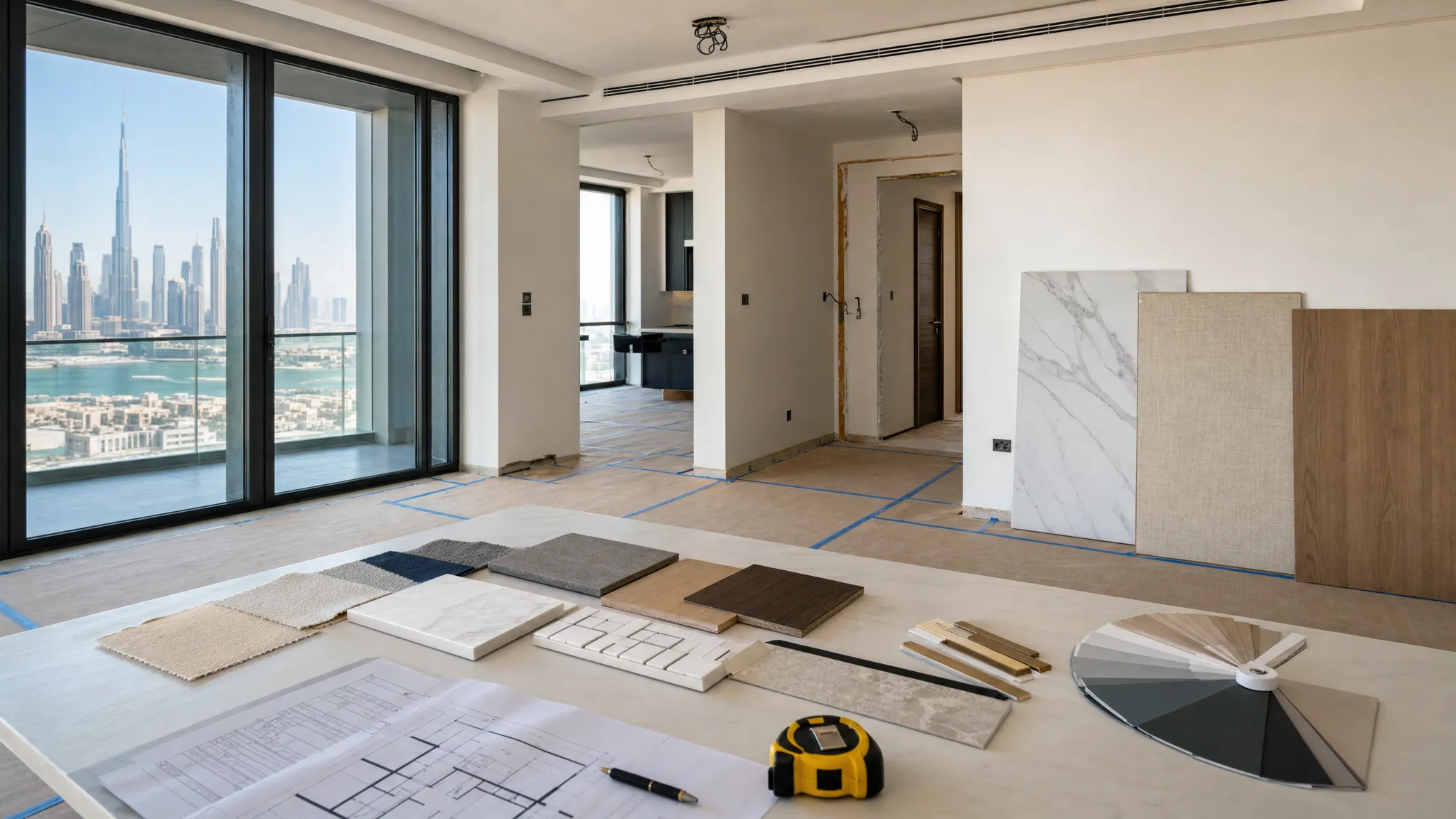
Make Key Decisions Earlier Than Feels Necessary
Renovation delays often happen because decisions are left too late. A homeowner may assume that tiles, lighting, sanitaryware, appliances, or cabinet handles can be chosen during construction. In reality, many choices affect measurements, MEP points, joinery production, and installation order.
For example, a wall-mounted toilet requires concealed tank planning before tiling. A kitchen island with appliances needs electrical and possibly plumbing coordination before flooring and cabinetry. A built-in wardrobe layout affects lighting positions and socket locations.
Use a decision schedule to avoid bottlenecks.
| Decision | Best time to finalize | Why it matters |
|---|---|---|
| Kitchen layout | Before MEP work | Determines plumbing, electrical, appliance, and ventilation points |
| Bathroom fixtures | Before waterproofing and tiling | Affects drainage, mixer positions, niches, and wall preparation |
| Flooring | Before door and skirting planning | Impacts levels, transitions, and installation sequence |
| Lighting plan | Before ceiling closure | Defines wiring, switches, dimmers, and ceiling cutouts |
| Joinery design | Before final paint and finishing | Requires measurements, production time, and coordination with walls |
| Paint and wall finishes | Before final finishing stage | Helps avoid rushed color decisions and mismatched textures |
Making decisions early does not mean rushing. It means giving yourself enough time to compare options properly before the site depends on your answer.
Think About How You Will Live During the Renovation
Living through a house renovation can be stressful if you do not plan for dust, noise, temporary service interruptions, and restricted access to rooms. If the renovation is extensive, moving out temporarily may be the better choice. If the work is phased, you may be able to stay in the home with clear boundaries.
Discuss site protection before work begins. Floors, existing furniture, elevators, corridors, and shared areas may need covering. In apartment buildings, protection of common areas is often required by management. In villas, consider access routes for workers, storage space for materials, and where waste will be collected.
Also plan for family routines. If children, elderly relatives, pets, or remote work are part of daily life, noise and access schedules should be discussed honestly. A renovation plan that ignores daily living usually creates frustration, even when the workmanship is good.
Communicate Like a Project Manager
Clear communication is one of the biggest differences between a smooth renovation and a stressful one. Every project should have one main point of contact, an agreed method for updates, and a process for approving changes.
Renovation planning has a lot in common with high-pressure event production: multiple suppliers, strict timing, visible results, and little room for confusion. Looking at how specialists handle complex, detail-heavy experiences, such as high-stakes event coordination, is a useful reminder that good outcomes depend on planning, sequencing, and clear ownership of every detail.
For your renovation, ask for written updates rather than relying only on phone calls. Keep decisions in one place, especially changes to materials, layout, cost, or schedule. If a variation is needed, request the price and time impact before approving it.
Good communication should feel transparent, not overwhelming. You do not need to manage every worker yourself, but you should always understand what stage the project is in and what decisions are pending.
Inspect in Layers, Not Only at Handover
Many homeowners wait until the final handover to inspect the work. That is too late for some issues. A better approach is to inspect at key stages, especially before work is covered by tiles, ceilings, cabinets, or paint.
For wet areas, waterproofing should be checked before tiling. For electrical work, switch and socket positions should be confirmed before walls are closed. For joinery, measurements and design details should be approved before production. For paint, surface preparation should be assessed before final coats.
Final snagging is still important, but it should not be the first serious inspection. At handover, check alignment, finishing, doors, drawers, silicone joints, drainage, water pressure, lighting controls, AC performance, paint touch-ups, and cleanliness. Document the snag list clearly and agree how remaining items will be closed.
Avoid These Common Planning Mistakes
Even well-intentioned homeowners can make decisions that create avoidable delays or extra costs. The most common mistakes usually come from starting too quickly, pricing too vaguely, or treating the renovation as a cosmetic project when technical work is involved.
| Mistake | Why it causes problems | Better approach |
|---|---|---|
| Starting without a detailed scope | Contractors may price different assumptions | Prepare a room-by-room scope before comparing quotes |
| Choosing finishes before checking site constraints | Design ideas may clash with plumbing, structure, or approvals | Complete a site survey early |
| Ignoring approval timelines | Work may be delayed by management or authority requirements | Confirm rules before setting the start date |
| Spending too much on visible items | Hidden technical work may be underfunded | Prioritize safety, waterproofing, MEP, and preparation |
| Making late changes | Changes affect cost, schedule, and trade coordination | Finalize key decisions before execution |
| Hiring based only on the lowest quote | Low pricing may exclude important items | Compare scope, quality, communication, and project management |
A good renovation plan is not about controlling every detail perfectly. It is about reducing uncertainty enough that the project can move forward with confidence.
Know When to Bring in a Professional Team
Small cosmetic updates may be manageable with limited coordination. But if your house renovation involves kitchens, bathrooms, electrical upgrades, plumbing changes, wall finishing, custom carpentry, or full interior transformation, professional planning becomes essential.
An experienced renovation company can help connect the design vision with technical reality. This includes reviewing the property, developing a practical scope, coordinating trades, advising on materials, managing timelines, and communicating clearly throughout the project.
Revo Craft Renovations works with Dubai homeowners and businesses on tailored renovation and interior transformation projects, including home renovations, kitchen remodeling, wall finishing, electrical and plumbing upgrades, custom carpentry, joinery, and project management. If you are still shaping your project, you may also find this related guide useful: How to Plan a Full Home Renovation in Dubai.
Frequently Asked Questions
How early should I start planning a house renovation in Dubai? Start as early as possible, especially if the project includes approvals, custom joinery, imported materials, or major MEP work. Early planning gives you more time to finalize the scope, compare options, and avoid rushed decisions.
Do I need approvals for every renovation in Dubai? Not always, but many renovations require some form of building management, community, developer, or authority approval. Requirements depend on the property type, location, and scope of work, so check before starting.
What should I prioritize if my renovation budget is limited? Prioritize technical quality, safety, waterproofing, electrical and plumbing reliability, and high-use rooms such as kitchens and bathrooms. Cosmetic upgrades can often be phased later.
Can I live in my home during renovation? It depends on the scope. Light upgrades may be manageable while living in the property, but full house renovations, bathroom work, flooring replacement, and major demolition can be disruptive. Discuss phasing, protection, and access before work begins.
How do I compare renovation quotations properly? Compare the scope, materials, exclusions, timeline, payment terms, project management, and warranty approach. A cheaper quote is not always better if it leaves out important preparation, technical work, or finishing details.
Plan Your Dubai Renovation With Confidence
A well-planned renovation protects your investment and makes the finished home more comfortable, functional, and visually refined. Before you begin, take time to define your goals, understand your property, confirm approvals, set priorities, and choose a team that communicates clearly.
If you are preparing for a house renovation in Dubai, contact Revo Craft Renovations to discuss your space, your goals, and the best way to bring your renovation plan to life with expert craftsmanship and organized project management.